
 SAM
SAM=Navigation%20(Current)12-2.png?width=17&height=17&name=Navigation%20(Current)=Navigation%20(Current)12-2.png) Maintenance
Maintenance =Navigation%20(Current)12-3.png?width=17&height=17&name=Navigation%20(Current)=Navigation%20(Current)12-3.png) Capital
Capital =Navigation%20(Current)12-1.png?width=17&height=17&name=Navigation%20(Current)=Navigation%20(Current)12-1.png) SAM™ Maintenance Request
SAM™ Maintenance Request SAM™ Supervisor
=Navigation%20(Current)12.png?width=17&height=17&name=Navigation%20(Current)=Navigation%20(Current)12.png) SAM™ Technician
SAM™ Technician SAM™ Capital Manager
 About us
  Contact Us
  Careers
  Customer Success Stories
=Navigation%20(Current)12-4.png?width=17&height=17&name=Navigation%20(Current)=Navigation%20(Current)12-4.png) SuiteSpot Accelerate™
SuiteSpot Accelerate™ Newsroom
 Integrations
 Resource Centre
 FAQ
FAQ Request a Demo
Why Multifamily Maintenance Needs a New Operating Model
Overview
Multifamily operators have spent the last several years rethinking how work gets done across the portfolio.
Leasing has changed. Administrative work has shifted. Centralized teams, regional models, automation, and AI have all pushed the industry toward a more efficient operating structure.
Maintenance has been harder to transform.
That is the focus of a new white paper from 20for20, developed in partnership with SuiteSpot. The paper examines why maintenance has not followed the same path as leasing or administration, and what operators should focus on instead.
The conclusion is clear: the next opportunity in maintenance is not simply centralization. It is control.
Control over the data behind the work. Control over the workflows that guide execution. Control over the communication that keeps residents, technicians, vendors, and leaders aligned. Control over the KPIs that reveal where performance is breaking down.
For operators trying to improve maintenance performance, that shift matters. Maintenance is no longer just a work order function. It is one of the clearest places where resident experience, operating cost, asset performance, and NOI meet.
Maintenance is more complex than a work order
Maintenance is often measured by speed. How quickly was the request assigned? How long did it take to complete? How many work orders are still open?
Those metrics matter, but they do not tell the full story.
A maintenance operation touches nearly every part of portfolio performance. It influences resident satisfaction, renewals, reviews, unit turn times, vendor spend, asset life, insurance exposure, and capital planning. A slow repair can create a resident experience issue. A poorly managed turn can delay revenue. A repeated appliance repair can become a capital allocation problem. A missed inspection can create risk.
That is why the white paper argues for a different view of maintenance. The goal is not simply to process more tickets faster. The goal is to manage maintenance as an enterprise capability, with the same level of visibility, consistency, and discipline operators expect from other core business functions.
The opportunity is better visibility and control
Many operators have improved leasing and administrative work by centralizing tasks. Maintenance is different because much of the work remains physical, local, and dependent on the condition of the asset.
A technician still has to diagnose the issue. A resident still expects a timely update. A supervisor still needs to know what is happening. A regional leader still needs to understand where performance is drifting.
That does not mean maintenance cannot be improved at scale. It means the path to improvement starts with the operating model.
The white paper identifies four characteristics of high performance maintenance organizations: a single source of operational data, standardized workflows, workflow driven communication, and KPIs that guide management action.
Together, those capabilities give operators a more complete view of the work. Instead of relying on scattered notes, disconnected systems, emails, spreadsheets, and local knowledge, teams can work from a consistent record of what happened, what needs to happen next, and where attention is required.
That is where better decisions begin.
Unit turns show what better maintenance looks like
Unit turns are one of the clearest examples of maintenance complexity.
They involve inspections, repairs, vendors, approvals, documentation, scheduling, resident communication, and leasing timelines. When those steps are managed manually, delays are easy to miss and difficult to diagnose.
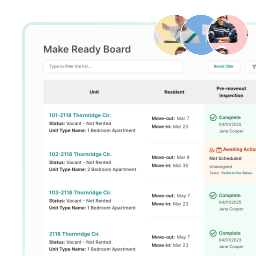
The white paper uses turns to show the value of a workflow based model. When the process is standardized, each step becomes visible. Teams know what has been completed, what is outstanding, who owns the next action, and where the turn may be at risk.
That same principle applies beyond turns. Preventive maintenance, inspections, vendor work, recurring asset issues, and resident service requests all become easier to manage when they are treated as connected workflows instead of isolated tasks.
The result is a maintenance operation that is more predictable, more measurable, and easier to improve.
AI needs the right operating foundation
AI is becoming a larger part of multifamily operations, but the white paper makes an important distinction: in maintenance, AI is most valuable when it is connected to the full operating context.
AI can help collect requests and communicate with residents. That has value. But the larger opportunity is AI that understands the resident, the asset, the service history, the current workflow, the technician’s needs, and the next best action.
That requires a strong foundation.
Without connected data and workflows, AI can automate individual interactions. With the right operating model, AI can help teams make better decisions, reduce manual coordination, surface risk earlier, and improve execution across the portfolio.
In other words, AI is not a shortcut around operational discipline. It amplifies the operators who have built it.
KPIs should help teams know what to fix
Maintenance KPIs are often treated as scorecards. Work order completion time. Turn time. Cost per unit. Vendor usage. Backlog.
The white paper argues that KPIs are more useful when they help operators diagnose the process behind the outcome.
A missed turn target does not explain itself. The issue may be inspection timing, vendor scheduling, unclear scope, staffing, approvals, parts availability, or communication. Better workflows make those breakdowns easier to see while there is still time to act.
That is the difference between reporting on maintenance and managing maintenance.
The best maintenance organizations use KPIs to guide attention. They identify exceptions, expose bottlenecks, and show where the operating model needs to improve.
The next era of maintenance performance
Maintenance improvement is not about finding one feature, metric, or staffing model that solves everything.
It is about mastering complexity.
The operators making progress are building a more controlled maintenance environment: shared data, consistent workflows, communication tied to the work, and KPIs that point leaders toward action.
As AI becomes more embedded in multifamily operations, that foundation will matter even more. The greatest value will not come from AI that simply answers a question. It will come from AI that understands the work well enough to help teams deliver it better.
For multifamily operators, maintenance is one of the most important opportunities to improve resident experience and financial performance at the same time.
The next advantage will belong to teams that manage it that way.
Faster Turns. Smarter Work.
See How SuiteSpot Can Streamline Your Maintenance
 Book a Demo
Blog
Resource library
Subscribe to learn about new product features, the latest in technology, solutions, and updates.